
Find Who Owns a Haskell Property
Work from the parcel, not the person. Haskell County offers no verified public owner-search interface, though Kansas law treats the owner's name and address as required appraisal-record fields. The current appraisal record gives you a working owner name fast. The newest recorded conveyance then supplies the stronger confirmation.
- Start with the property's complete situs address, not the owner's mailing address.
- Ask the Haskell County Appraiser to match the address to its parcel/map identifier, legal description, and current owner-of-record field.
- Carry the exact legal description and owner name to the Haskell County Register of Deeds.
- Locate the newest deed or other conveyance affecting that same land and compare its grantee, execution or recording date, and book/page or instrument reference.
- If the names conflict, ask whether a recent deed has not reached the assessment roll and check for later corrective, estate, trustee, or transfer-on-death instruments.
Followed in order, this method answers "who owns this property?" without mistaking a tax mailing recipient, map label, or city permit applicant for proof. For live parcel-card detail, continue to the current property owner guide. For history, turn to the former owners guide.
Where Haskell County Shows an Owner
Each source records a different relationship to the land. A careful owner lookup keeps those roles in separate columns rather than treating every displayed name as title ownership.
| Haskell source | Name or evidence supplied | Practical access |
|---|---|---|
| County Appraiser record | Owner name and address, parcel description, classification, taxing unit | Phone, mail, or courthouse request; public search not verified |
| Register of Deeds index/instrument | Grantor and grantee on the recorded conveyance | Phone, email, mail, counter, or KORA request; web index not verified |
| Appraisal map/GIS | Parcel geometry and possibly linked attributes | County interactive link referenced, exact viewer/tools not verified |
| Kansas Secretary of State | Entity name, status, resident agent, filing address | Online business entity search |
| City permit or zoning file | Applicant, contractor, project, lot, or address | Sublette or Satanta city request; supporting evidence only |
The Appraiser sits at 620-675-6289, P.O. Box 518, Sublette. The Register of Deeds directory lists 620-675-8343, 300 S. Inman, P.O. Box 656, Sublette, plus email and 8:00 a.m.–5:00 p.m. hours. Confirm contacts before you travel.
Read the Haskell Owner Field Carefully
Under K.S.A. 79-1459, an appraisal record must show the owner's name and address alongside classification, taxing unit, parcel description, building data, and values. That makes the owner field an efficient first answer. The label's exact wording and its refresh schedule on the county's present system are not published.
- Owner of record
- The name carried on the current county appraisal roll.
- Grantee
- The person or entity receiving an interest in a recorded conveyance.
- Vesting
- The way the instrument states that title is held, including named parties and stated capacity.
- Situs address
- Where the property physically lies.
- Mailing address
- Where the county sends owner or tax correspondence; it may be elsewhere.
A homestead, occupancy, or exemption indicator, when a card shows one, never proves who lives on the land. Answer ownership through the roll and the conveyance instead. Do not infer it from a tax category.
Keep Haskell Situs and Mailing Addresses Apart
A farm often lists a rural route or post-office box. Its stable identifier is a section-township-range description. A town house may carry a street situs. It can also carry a separate lot, block, and addition description. An out-of-county owner, trust, lender, or tax service can send correspondence somewhere far from the land itself.
When you ask who owns a Haskell County property, give the Appraiser both the physical address and the legal description. Label any owner mailing address separately in your notes. The USPS ZIP lookup helps only with mail formatting. ZIP codes are delivery geographies. They are not city limits, parcels, or proof that an addressee holds title.
Note: A tax-mail address identifies a delivery destination; it does not establish occupancy or replace the grantee named in the latest deed.
Confirm the Name With Haskell's Latest Instrument
The Register of Deeds preserves deeds, transfer-on-death deeds, trustee and estate deeds, affidavits, plats, mortgages, releases, easements, and more. Other instruments affecting real property are kept there too. Kansas requires both a general grantor index and an inverted grantee index. That paired structure lets a researcher trace exactly how the current owner of record acquired the land.
Request the newest conveyance tied to the exact legal description. Then compare the grantee's full vesting name, deed type, date, description, and recording reference against the appraisal roll. A mortgage or lien names an owner and lender. But it is not the conveyance that establishes a new one. Treat a deed index entry as a locator only. Read the instrument image or copy before concluding anything. The Haskell deed records page covers deed types and copies in depth.
When Haskell's Roll Still Names the Seller
A closing can be recorded before the appraisal database catches up. The county publishes no fixed update lag, so promise yourself no number of days. The roll may still name the seller. A newer recorded deed conveys the same legal description. Note both record dates. Then call the Appraiser and ask the roll's effective date.
Check whether the conflict stems from a correction deed, trustee or executor capacity, a transfer-on-death instrument, a probate order, or a split parcel. It may also stem from a mismatched legal description. The latest deed remains the stronger evidence of a recent conveyance. Bring in a title professional when multiple instruments or exceptions cloud the picture.
Recent-sale gap. The Haskell appraisal roll can update after recording; compare effective dates rather than assuming either displayed name is timeless.
Identify LLC Owners on Haskell Deeds
When the owner or grantee is an LLC or corporation, search the exact legal name in the Kansas Secretary of State Business Entity Search. You can query by business name, Kansas business ID, or resident-agent name. Name searches offer Contains or Starts With options and return at most the first 200 results, so use a partial keyword when needed.
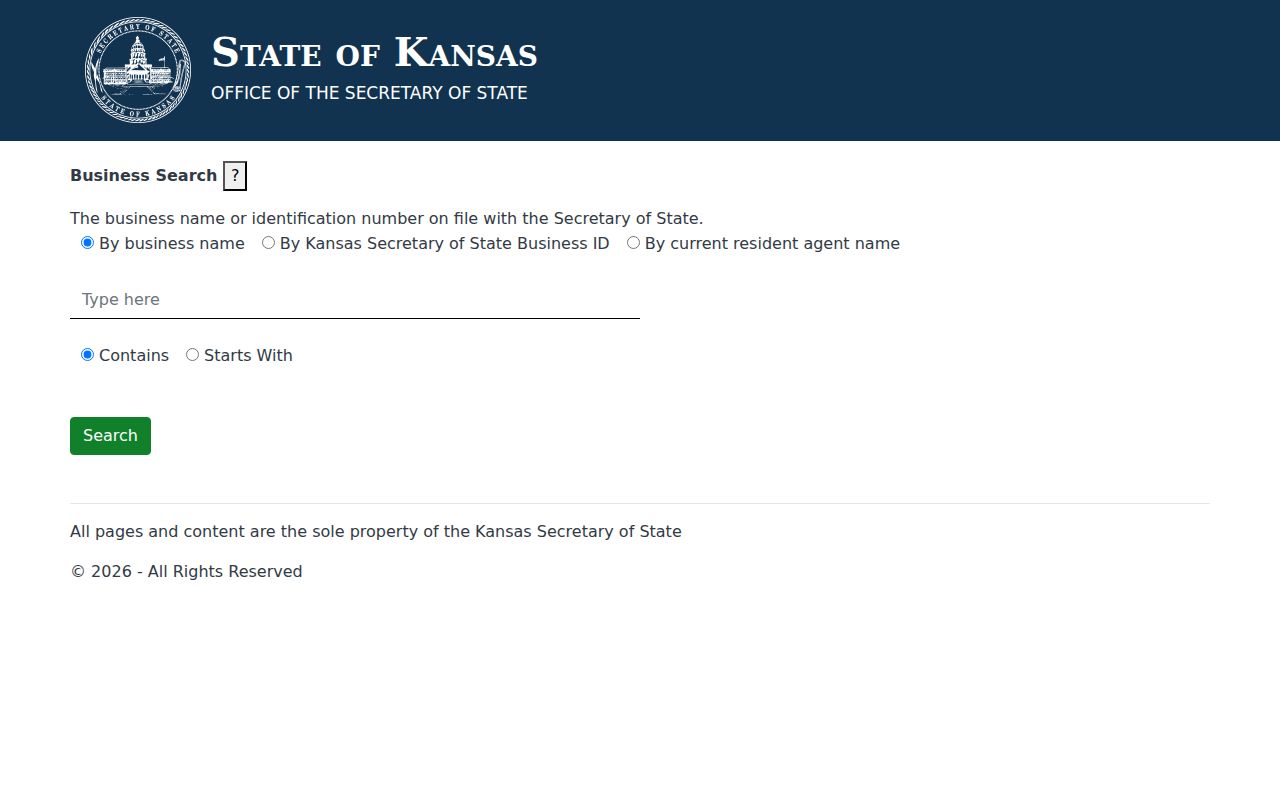
The result may show entity status, resident agent, filing address, and filings. It does not reveal every beneficial owner, cover every sole proprietorship or trade name, or override the deed's vesting language. A trust or estate may call for the recorded instrument and the relevant probate record rather than any business search.
City Files Support Haskell Ownership Research
City files can crack a Haskell County ownership question. Sometimes an address or subdivision name alone goes nowhere. Sublette zoning and subdivision files name the landowner, applicant, or lot split tied to a project. They also list any plat, variance, or address involved. Satanta's permit menu works the same way. Its items include a building-moving applicant or a Northern Plains Subdivision free-lot application. Each file is a useful cross-check.
Start with the Sublette zoning materials. Or try the Satanta forms and permits to pull the project file. Then verify the legal description it contains with the county. A permit applicant might be the owner of record. The name could instead be a contractor, a prospective grantee, or another participant entirely. City halls in Haskell County are helpful stops. But they have not replaced the County Appraiser or Register of Deeds as the custodians of property records.
Offline Haskell Property Owner Search
Haskell County publishes no online owner field, deed-image viewer, GIS popup, or roll refresh schedule. A written request is the honest path. Keep it narrow. Ask the Appraiser for the current owner as displayed, the assessment-year effective date, mailing and situs addresses, the legal description, and the parcel or map identifier. Also request any available card fields. Ask the Register of Deeds for the latest non-exempt conveyance. Request the recording reference affecting that description too.
The Kansas Open Records Act FAQ describes the timeline. Agencies should respond as soon as possible. The end of the third business day is the latest. That first reply may grant access, estimate cost or time, or explain a delay. Request existing records and electronic delivery. Ask for a fee estimate too. If any portion is withheld, request the statutory citation supporting it.
Older Haskell Owners and Finney County
Haskell County was organized from part of Finney County in 1887. That matters for old deeds. Pre-organization transactions may sit in Finney records or in later transcripts. Early legal descriptions can also carry names like Santa Fe, Ivanhoe, Loco, Stowe, or Lockport. These communities no longer appear as current cities in the county.
The Kansas Historical Society post-office database turns a vanished place name into a stronger deed-search clue. Pair it with the section-township-range or lot-block-addition description. Then return to the recorded instruments themselves. Historical leads can stretch a property search back decades. But they will not tell you who owns the property today.
Limits of a Haskell County Ownership Finding
An appraisal-roll name is not a title opinion. It does not establish who occupies a building. A recorded deed can be undone by later instruments, probate, unrecorded interests, legal-description errors, or litigation. LLC and trust names can lawfully separate an individual from the vesting. That vesting is what shows in public property records. Kansas Safe at Home adds another layer. It protects eligible participants through a substitute address and mail forwarding.
Put owner information to legitimate uses. Property due diligence qualifies. Boundary and easement research qualifies. So do assessment questions, purchase verification, fraud prevention, and estate work. Do not publish sensitive personal details without reason. And never use any record to threaten, stalk, harass, or harm a person.
Record name, not title guarantee. Confirm the Haskell owner field against the newest recorded deed, and obtain professional title work when legal ownership must be established.